


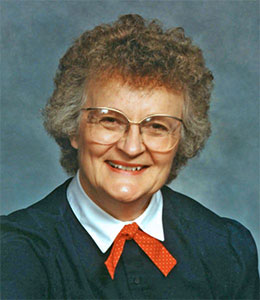
In 1988, Naomi said she believes her ancestry is: 9/16 German, 1/16 Swiss, 4/16 English, and 2/16 Irish.
From her e-mail to me (Dennis Reust) on 7 Dec 1998: "Oh, yes, this is Pearl Harbor day. I remember that day in 1941. It was Sunday, and not having much of a radio, we did not know until we got to church at night and were told. It sure put a hush on things, as we knew our men would go to war. Loran was teaching school in Guymon that year, but he quit and went to the Air Force. Brothers-in-law Warren and Clyde also went. Those were very hard years on our family. I wish there was a way to convey the real hardships we went through during those years. Tires were rationed, as was food, and other things important to us. They quit making cars, so people's cars got old. Of course there was the horrible fear that the men would not come back, many did not, but our family survived. It was always a wonderful day when one of them came home."
Family story distributed by Richard & Brenda Clason in 2005:
"Perhaps you need to know about the sister that was real curious as to how her little brother would look if he had been born a negro, so she persuaded him to stand by the farm wagon wheel and let her smear his face with axle grease. About the time he was turning black, he decided he did not like it and started crying and ran to the house. Don't ask what happened next, but I assure you, the sister did not think it was so funny anymore. Who was the brother? James. That would be a good one on him. Sure could stand getting away from the 'siccing dog on Mamma' story that has been told since I can remember. I have that taped from 1989. Who was the sister? Naomi."
In 2006, Naomi wrote the following autobiography: NAOMI RUTH TOEPFER
"I arrived as the fourth child of Ernest and Gertrude Toepfer on November 10, 1924. My parents were proud to give me two names from the Bible, Naomi Ruth. There were two sisters and an older brother in my world, and since my brother wanted a new brother and I was another sister, he allowed he'd rather have had a puppy.
Situations in my family around the time of my arrival, did not contribute to my happiness as a baby. They said I cried a lot and that dad often walked the floor with me. I cannot vouch for this, but perhaps I was hungry or perhaps the family did not have time to give me proper care. It was during this time that Mom developed migraine headaches and was physically in no condition to care for four children with one of them being a small baby. Dad and Mom decided to move to Iowa to be close to Dad's family, hoping his sisters would help care for the children. The lack of finding a good job and the lack of help from siblings, eventually made my parents realize that the move to Iowa was a big mistake. They collected all the money they could, bought train tickets and headed back to Oklahoma. It took several months for them to become established on the farm and in the house that Dad's brothers had built back in 1910. This farm was located eight miles west and four and one-quarter miles south of Kingfisher in the Park Community. It was good to be back home again.
We did not have electricity, nor did we have natural gas or running water. We used kerosene lamps to see by and usually went to bed very early in the winter. The lamps gave so little light that there was not much reason to stay up. The wood heating stove usually burned down until there was not much heat in the house, so the best place for us was in bed where, under many covers, we tried to keep warm.
One memory of my very young years was feeding the chickens with my Dad. He carried a bucket with grain in it and scattered the grain across the yard with circular movements of his hand. I was happy when he would let me get a handful of grain and throw it out and watch the chickens come for it.
I started to first grade in September 1929 when I was five years old. The school was a rural two-room schoolhouse located one and three-quarters mile from home. Some years I went to school in a horse drawn buggy, some years I rode horseback and then I rode in a Model A Ford with some neighbor kids. The buggy afforded a cold ride in winter. Although we had a blanket to cover up with our feet would get very cold. Being a girl, I wore dresses and long stockings to school. My dress and coat would not always meet where my stockings stopped on my thigh and my bare leg really got a lot of cold air when I was riding my pony. How wonderful pants would have been, had they been a part of what girls wore then.
Our pony was white with brown spots, a pretty animal. My younger brother (James) rode behind the saddle on the horse. One morning going to school three girls were tromping across the bridge just south of the corner where we turned north. The horse became frightened and started running. This scared me and I started shouting at the horse, which further frightened the horse. In the process of the running horse and the screaming rider, little brother slid off the back of the horse. Then I was really scared. Had I killed my brother? When I finally got the horse to stop and got off to check on brother, he was a little shook-up but was fine. What a relief that was. He got back on and we continued our journey to school. I graduated from eighth grade in 1938 and that was the end of school at Park.
Omega school arranged for one of their busses to come to our community, as there were several of our neighbors who would attend Omega High School, providing we could have transportation. The bus was made with a wooden box to ride in. There were bench seats on each side of the bus and a bench down the middle. Mother was concerned about the rough ride her daughters were getting and she sewed together pieces of denim and added some padding and fitted it to the seats in that bus. We were very cold in winter when we arrived at school because there were no heaters in the bus and we rode the entire twenty-seven mile route. We did not consider ourselves mistreated, we were thankful for a ride so we could attend high school.
I liked my mathematics classes, my music class and my typing class and I was good at doing memory work in English and literature class. Other classes I tolerated. I graduated with a class of 16 seniors in 1942.
I was determined to go on to college and my parents said I should stay home and help around the house first. When I kept insisting that I could work my way, they allowed me to try, with dad telling me I would never make it. It turned out that he was right as I did not get to graduate, but it certainly was not because I did not try.
I went to Bethany, OK and worked for the college at fourteen cents an hour, earning tuition. With a war going on, many of the young men were not available, so my work consisted of painting, cleaning dorm rooms, and varnishing the large dining room floor. My sister lived in Bethany and worked with me that first summer. Tuition was $40 a semester for as many hours of study as you could take. By the time school started we had worked enough to pay tuition. I got a job at a local drug store and worked from 6:00 p.m. to 10:30 or 11:00 p.m. to earn money for room and board in the dormitory. I had little time to socialize, but that was OK, I was doing what I wanted to do.
During the summer I worked more hours and saved money for the next year. I was making it fine, working and going to school, until the summer after my sophomore year. I developed appendicitis and had to have surgery. Medical techniques were much more crude back then. I was in the hospital eleven days and at one period of time there was doubt that I would live. After I came from the hospital I still was not doing good and visited the doctor again. He opened a pencil size hole at the bottom of my eight-inch incision and allowed a lot of unnecessary matter to come out and then left the hole open so it could drain. I was still quite weak when it was time to go back to school, but my goal remained that I wanted to go to school. In November of that year I was feeling stronger and started working at the drug store again. My body was just not cooperating with my desire to study and by mid-term of my junior year I had to give it up. I went back to live with my parents that year, hoping that I could resume study later.
In the State there was a need for teachers, as so many men had been called into military service. I found that I had enough credit in mathematics and science that I would be allowed to teach, so I put in a few applications and was accepted for a position in Newcastle. This was an enjoyable year for me. I loved teaching and I was only a few years older than the high school students I was teaching
After one year of teaching, my friend came home from Korea and we were married. At this time, I moved out of Kingfisher County.
For a short summary of life after marriage, I became the mother of two sons and one daughter. I spent several years raising my family. In 1960 I started working for an engineering firm, which proved to be a very fitting occupation for me, as I was happy working with numbers. I did typing, printing, bookkeeping, payroll, I worked on maps, filled out many government forms, figured cost estimates, and other projects typical of a small engineering firm. Later, I worked for a larger firm. I did the maintenance manual to accompany construction of a new sewage facility. I wrote environmental reports and prepared the maps to go with the reports. I prepared financial profiles for rural electric cooperatives and wrote informational letters regarding the profile.
It is impossible to explain the many facets of engineering work, but I have been most grateful for the opportunity to work in this field of service. I retired in 1994 and it was difficult for me to adjust to staying home, because I loved the work I was doing.
Through the years I was very dedicated to my church and served where ever I could to assure that the story of Love continued to be told to everyone. I enjoyed singing in the church choir and teaching Sunday school classes. I have been to Mexico twice on a missionary endeavor. The years are now creeping up on me and my active participation is much less, but I hope to stay 'alive' as long as I live, and continue to do what I can to keep myself moving and enjoying the life I have been given." by Naomi Toepfer Tidwell, 5805 North Mueller, Bethany, Oklahoma 73008.
During her visit to my house on 11 mar 2010, my mother Naomi said her mother wanted 3 children, and she was number four. When she was born, her older brother Loren said he would rather have had a puppy. My mother didn't really feel wanted during her childhood. I think this is consistent with the family photo of 1938 in which the family is huddled together except for Mom who is standing more aloof with her head tilted outward. She said an important scripture in her child hood was Ephesians 6: 1-3 (KJV) "Children, obey your parents in the Lord: for this is right. Honour thy father and mother: (which is the first commandment with promise;) That it may be well with thee, and thou mayest live long on the earth." She said she wanted to live a long life, and so was diligent to obey her parents. She thought her parents called on her more because of it. For example, whenever the water supply in the house was exhausted, they would call for her. She had to drop anything she was doing, fetch the bucket from the house, go to the well, and pump one or two buckets of water and take it to the house. By contrast, her older sister Evelyn was fussy and would complain when told to do something, and her younger brother James was lazy and would find ways to do less work. She again told of hoeing the garden with James. Mom would take two rows and James one row, and when she finished her two rows, she'd often have to return and help James finish his row.
On 9 Jun 2010, Naomi wrote the following story about the history of The Church of The Nazarene in Kingfisher, OK: "There was to be a revival meeting in the 'Park' community. A tent was set up near the creek that is one-half mile south of where we lived. I am not sure but possibly "Ernest Armstrong" was to be the minister. There is another name in my mind, that the man must have had something to do with the meeting, that name is 'Jarvis'. Mamma said that Armstrong was so passionate about winning souls to Christ that he sweat some blood. The meeting started and 'rain' started and it was one of those rains where Oklahoma creeks get way out of bounds. It rained so much the creek started rising and the rain was still coming down so the men got together and took the tent down so it would not get ruined. They set it back up in the 'Toepfer's' yard, and the meeting continued. A revival meeting was a type of entertainment in those days and people came and many of the neighbors in the community accepted Christ as their Savior.
I do not know where the church was organized, but it then met at rural Cooper School, about 3 to 4 miles from our farm. When I was about 2 or 3 years old, we were meeting in the Alpha Community Church building. This church was about ten miles west and one mile north of Kingfisher. I remember what we had to do to get a drink of water at this church. There was a well and a pump. A pipe extended out perhaps 10 or 12 feet from the water spout and water would go into this pipe which had spaced holes in it where water would spew up and this was our water fountain. I remember that we had theater-type seats in this building. Do not know how long we met here for church, but they decided that we needed to move to Kingfisher to have a better church organization.
A frame building was built (the stone church was at 7th & Wyatt) just north of the later location of the stone church. This simple building with just a pitched roof all the way, became the church meeting place and a home for the pastors family. There were three small rooms across the back of the building for the pastor and later they put up a curtain and claimed a part of the auditorium for the pastors family. (In my minds eye, I can still see it, but it is hard to describe.)
I remember singing, reciting Bible verses, and praying in this building. A man by the name of Pitts was pastor, and Fred Stockton, and others. Then Arthur Green was pastor and he helped to start the stone church. Dad and Clyde Nice and Harold Wallace did a lot of the work to go to the quarry and get the rocks and haul them to town for the stone church. It was probably 15 or 20 miles that they hauled the stones from the jip (gypsum) hills. (As I think about it, I believe Fred Stockton was at the Alpha church)
The basement for the church was dug and I believe some of the concrete was poured, and times got so bad that they had to stop the building process. It was quite a worry for them to have the open hole when big rains came. Seems like it was about 3 years before they could start building again. It was built with double rock wall and the rocks were left natural on the inside. John Brown had equipment and he made the pews. (John later moved to Bethany and repaired lawn mowers.) People helped sand and finish the pews. Most, if not all of the labor was donated, mostly by people of the church.
There was a limited period of time that the church met in the "Memorial Hall" at Kingfisher. I do not remember the reason, but probably had to do with transition and building. The stone building was used for church, and the frame building where we had been meeting was all used as the parsonage. The location at 7th. and Wyatt was used until moving to the campus now occupied by the Nazarene church."
In December 2010 Naomi related the following to her son Dennis: She said she sang early and was one of the more skilled singers in her class. When her school met with other schools of the district for a combined musical event she was a soloist from 2nd through 5th grades. However she was very shy, and in the 5th grade, was too frightened to sing her part. She learned a lot of Church hymns, and has hundreds of them memorized to this day, though her voice was damaged about a decade ago in a neck surgery. At about age 4, she made a mistake her family still laughs about by singing the hymn "In the City Where They Need No Sun" as "In the City Where The Negroes Run."